Music Hop: Rhythm Ball Games
- 4.4
- Rating
- 5.00M
- Installs
- Free
- Price

 Analysis by App-foxy
I approached Music Hop: Rhythm Ball Game as a quick music game rather than a traditional rhythm-training tool, and that distinction matters from the first minute. The basic idea is easy to understand: keep a bouncing ball moving across music tiles while following the beat. It feels designed for short sessions, quick retries, and the small satisfaction of finally staying in time through a section that initially catches me out.
The game comes from Beatwave Studio and sits in the music category. It is free to play, carries an Everyone age rating, and supports devices running Android 7.0 or later. The current release is version 1.4.6, while the game itself arrived on July 24, 2025. Those details make it approachable for a wide range of Android users, especially anyone looking for something lighter than a full music-learning app.
What the first session actually feels like
The opening experience is deliberately simple. I do not need to learn a complicated control scheme before playing. The important action is timing: I watch the moving ball, listen to the song, and try to make the next landing happen with the music rather than merely reacting after the tile appears.
You May Also Like

 Blood Strike: 2.5 Anniversary
Blood Strike’s Loadouts Turn Every Drop Into a Tactical Gamble
A close look at Blood Strike’s custom loadouts: how fast access to signature weapons reshapes its battle royale rhythm, rewards preparation, and narrows the gap between fights.

 Pandora - Music & Podcasts
Pandora’s Music Is Easy to Start, but Harder to Recover
Pandora’s strength is its low-effort path from a seed to a station. Its weak spot is how much confidence it asks you to place in connection, setup, and quiet recovery.

 8 Ball Pool
 Is Built on Rivalries, Rematches, and Routine
A close look at the rivalries, rematches, shared routines, and unanswered safety questions that turn a quick pool match into a persistent mobile community.

 Samsung Music
’s Quiet Strength Is Playing What You Already Own
Its reach comes less from spectacle than from dependable access to a personal library. That simplicity is both the app’s strongest retention engine and its ceiling.

 AccuWeather: Weather Radar
AccuWeather Review: A Quick, Clear Forecast for Everyday Decisions
For everyday plans, the best forecast is the one you can understand quickly. AccuWeather makes rain timing, radar, and local conditions easy to act on, with a few trade-offs.

 Hill Climb Racing
Why Hill Climb Racing Still Turns Crashes Into One More Run
A tiny car, a bumpy hill and one more upgrade: Hill Climb Racing keeps resurfacing because its simple chaos makes every near-miss feel personal.
More From Our News Desk



That sounds straightforward, but the visual movement can tempt me into tapping too early. My most useful adjustment was to stop treating each tile as an isolated target. Instead, I listened for the repeating pulse and used the ball's current movement as a visual confirmation of a beat I had already heard. That small change made the game feel less frantic and helped me reach successful runs sooner.
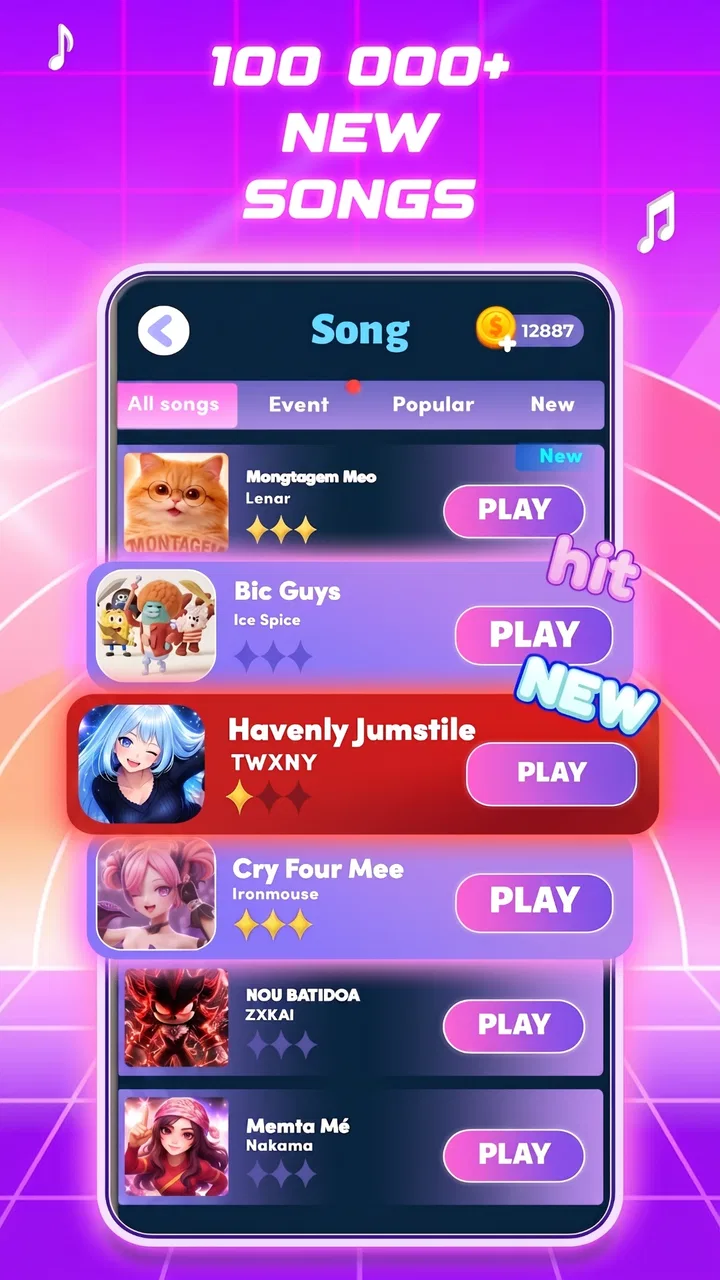
The store summary points toward trending songs, so the appeal is partly musical recognition. Familiar tracks can make a stage immediately inviting, but they can also create a trap: knowing the song does not automatically mean I know the timing of the game. The tile path still demands attention, and a chorus I can sing along with may contain a rhythm that is less comfortable to play.
For a first-time player, I would set expectations around short bursts of concentration. This is not the kind of app I open expecting a long story, character development, or deep strategy layer. Its strength is the compact loop of hearing a track, attempting the path, noticing where timing slipped, and trying again with a better sense of the rhythm.
Getting from installation to the first useful attempt
After installing it, I recommend starting with sound enabled and keeping the volume high enough to hear the pulse clearly. Playing silently is possible in the practical sense, but it removes the game's most helpful source of information. If I am in a noisy place, headphones make the timing easier to follow, provided I can still remain aware of my surroundings.
I also suggest beginning with a relaxed hand position. Holding the phone too tightly makes quick taps feel more dramatic than they need to be. I found it easier to keep the device steady, focus on the next landing area, and let the music guide the moment of contact. This is particularly useful on a smaller screen, where a tense grip can obscure part of the play area.
The first meaningful success is not necessarily completing a difficult song. It is learning to make several accurate landings in a row without chasing the ball visually. Once I could anticipate the beat instead of waiting for the ball to reach the edge of a tile, the game became much more readable. That is the point where the simple premise starts to feel like a real rhythm challenge.
A practical routine helped me more than repeatedly playing without reflection. On an unsuccessful run, I paid attention to whether I missed because I tapped late, tapped early, or lost track of the next tile. An early mistake often came from reacting to the animation, while a late one usually meant I had stopped listening. Identifying that difference made retries feel purposeful instead of random.
How to build timing without turning it into homework
I would not approach this as a formal lesson in musical timing. It is better understood as a game that rewards coordination between hearing and seeing. Still, it can sharpen a useful habit: keeping a steady internal pulse while responding to changing visual targets.
One technique is to quietly count the beat during a difficult passage. I did not need to count every note; I used a simple internal rhythm and let the tile movement tell me when the next action was due. This worked especially well when the song became familiar enough to distract me. Counting brought my attention back to the timing task.
Another useful approach is to play a song twice for different reasons. On the first attempt, I listened for its general pattern and accepted mistakes. On the second, I concentrated on the section where my timing broke down. This is more efficient than restarting immediately after every error, because the first run gives me context for what is coming.
There is also a trade-off between looking at the ball and looking ahead. Watching only the ball helps with immediate control but can leave me surprised by the next tile. Looking too far ahead can make the current landing feel rushed. I had better results by checking the next target just after each successful bounce, then returning my attention to the ball's current trajectory.
These habits are not advertised as advanced systems, but they are where much of the practical improvement comes from. The game stays accessible because the controls are uncomplicated, while the timing still gives experienced players something to refine.
Where new players are most likely to get confused
The biggest source of confusion is assuming that a familiar song will automatically make a stage easy. Musical familiarity helps me predict the general pulse, but the game still asks for visual coordination. A track can feel comfortable to listen to while its tile sequence remains demanding to play.
Another common mistake is tapping whenever the ball appears close to a tile. That instinct is understandable, yet closeness is not always the same as the correct musical moment. I had to learn to connect the landing with the beat rather than with the apparent distance on screen.
When a run goes badly, I would avoid changing several things at once. If I alter my grip, volume, viewing position, and timing strategy simultaneously, I cannot tell what helped. A better method is to make one adjustment, such as listening more carefully to the pulse, and then test it on the next attempt.
Screen position can matter too. Playing while walking, riding in a vehicle, or holding the phone at an awkward angle makes a timing game less forgiving. For a short session, placing the device securely and keeping my eyes at a comfortable angle made more difference than I expected. This is a game where physical steadiness supports musical accuracy.
It is also worth remembering that repeated failure can come from fatigue rather than lack of ability. Because the basic loop encourages another attempt, I can easily keep playing after my attention has started to fade. When I notice that I am missing simple landings, taking a brief pause is usually more effective than forcing another retry.
Using it in an ordinary day
I can see Music Hop fitting naturally into a short break. For example, after finishing a task, I might play a song or two while waiting for a meeting, a download, or a friend. The session has enough immediacy to feel rewarding without requiring me to remember a complex plot or rebuild a long-term setup.
It also works as a casual shared activity. One person can listen and play while another comments on the timing or recognizes the song. That said, it is not ideal for every social setting. If the environment is loud, the musical cues become harder to follow, and if I am trying to hold a conversation, my performance drops quickly.
For younger players, the Everyone rating makes the game broadly approachable, but I would still treat it as a timing game rather than an educational guarantee. It may encourage attention to rhythm and coordination, yet the main purpose is entertainment. Adults who want structured music practice, instrument instruction, or detailed feedback should look elsewhere.
The game is also a reasonable choice for someone who likes music-themed casual games but does not want a large download filled with unrelated systems. Its focus is narrow, which is both its attraction and its limitation. I can get into a run quickly, but I should not expect the range of activities found in a full music platform.
How it compares with familiar alternatives
Compared with a traditional rhythm game built around lanes and note charts, Music Hop feels more physical and visually direct. The bouncing ball gives me a clear object to follow, while lane-based games often ask me to read several streams of notes at once. That makes this game easier to approach during a first session, especially for players who find dense charts intimidating.
The trade-off is depth. A specialized rhythm game may offer more control over difficulty, more detailed scoring, or a stronger sense of progression. Here, the pleasure comes from the immediate relationship between the ball, the tiles, and the song. If I want technical mastery of a chart, another rhythm title may suit me better; if I want a quick attempt with a low learning barrier, this format is friendlier.
It also differs from music streaming. Streaming lets me choose a song and listen passively, while this game turns listening into a task. That can make a familiar track feel fresh, but it also means I cannot fully relax while playing. Someone looking for background music should use a music player instead.
Against instrument-learning apps, the distinction is even clearer. This game may help me notice a pulse and coordinate actions, but it does not replace practice on piano, guitar, drums, or voice. Its value is playful engagement with rhythm, not a curriculum, notation system, or personalized lesson.
What the audience size tells me, and what it does not
The game has reached over five million installs and holds an average rating of 4.4 from around thirteen thousand ratings, with just over a hundred written reviews. That level of adoption suggests that the basic idea has broad casual appeal, while the written feedback is a smaller window into individual experiences rather than a complete picture of every player's needs.
I would read those numbers as reassurance that the concept is easy for many people to pick up, not as proof that every song or session will suit every taste. Music preferences vary, and rhythm-game tolerance varies even more. The strongest reason to try it is still the simple loop: if bouncing through music tiles sounds enjoyable to you, the game gives that idea a direct way to test itself.
Who should try it and who should skip it
I would recommend it to casual players who enjoy recognizable music, quick retries, and games that can be understood without a long tutorial. It is especially suitable for someone who wants a small challenge during spare moments and likes improving through timing rather than through complicated upgrades or planning.
I would be more cautious recommending it to players who need precise rhythm-game controls, extensive customization, or a substantial progression system. If your main goal is competitive chart mastery, instrumental practice, or uninterrupted listening, a different category of app will serve you better.
Players who become frustrated by repeated misses should also know what they are signing up for. The controls may be simple, but the timing loop can still expose small inconsistencies in attention. Its accessibility comes from the easy-to-understand action, not from guaranteed success.
My next-step advice after the first success
Once I had completed a comfortable run, I found it tempting to jump straight to the hardest available challenge. A better next step was to choose a song with a different rhythmic feel and test whether my timing skill transferred. That exposed whether I had learned the underlying pulse or had simply memorized one sequence.
I would also keep the audio setup consistent while learning. Changing from speakers to headphones can alter how clearly I perceive the beat, so I prefer to practice with one arrangement until the timing feels stable. After that, switching environments becomes a useful test of adaptability rather than an unnecessary source of confusion.
Another small improvement is to stop a session after a genuinely good attempt instead of playing until concentration collapses. Ending on a successful run leaves me with a clear sense of timing to bring back later. It also prevents the familiar cycle of turning a relaxing break into a frustrating string of automatic retries.
Beatwave Studio has kept the concept focused, and version 1.4.6 represents the form I reviewed. The free entry point and Everyone rating make it easy to try, while support for Android 7.0 or later keeps the technical requirement modest. I would still make sure my device is comfortable to hold and that I can hear the music clearly before judging the game.
My overall view is positive, with a clear boundary around that praise. Music Hop: Rhythm Ball Game is not a replacement for a serious rhythm-training app, a full-featured music game, or a streaming service. It is a compact way to turn songs into short coordination challenges, and it succeeds when I treat it on those terms.
The best way to enjoy it is to listen first, react second, and use each retry to understand one timing mistake. If that sounds like the kind of small, repeatable challenge you want from a free music game, I think it is worth installing and giving the first few songs a patient try.
FAQs for Music Hop: Rhythm Ball Games
01What is Music Hop: Rhythm Ball Game about?
Music Hop: Rhythm Ball Game is a rhythm-based mobile game where players guide a bouncing ball along a path synchronized to the beat of popular tracks. The objective is to keep the ball hopping on tiles while matching the rhythm, creating an immersive musical experience. It's available on both Android and iOS.
02How does the gameplay work in Music Hop?
In Music Hop, players control a ball that bounces along a series of tiles. The game requires precise timing and rhythm to keep the ball moving in sync with the music. Players must tap the screen to make the ball jump to the next tile, avoiding gaps and obstacles while staying on beat.
03Are there in-app purchases in Music Hop?
Yes, Music Hop offers in-app purchases. Players can buy additional songs, unlock special themes, or remove ads to enhance their gaming experience. While the game is free to download, these purchases can provide a more personalized and uninterrupted gameplay experience.
04What kind of music tracks are available in Music Hop?
Music Hop features a wide range of music tracks, including popular hits, EDM, and classical pieces. The game regularly updates its library to include new and trending songs, providing a fresh experience for players who enjoy different musical genres while playing.
05Is Music Hop suitable for all ages?
Music Hop is designed to be family-friendly and suitable for players of all ages. Its intuitive controls and engaging gameplay make it accessible to children and adults alike. However, some songs may contain mature themes, so parental guidance is advised for younger players.
Pros
- Engaging rhythm-based gameplay.
- Vibrant and colorful graphics.
- Wide variety of music tracks.
- Simple and intuitive controls.
- Regular updates with new content.
Cons
- In-app purchases can be costly.
- Limited offline functionality.
- Advertisements can be intrusive.
- Requires precise timing skills.
- Repetitive gameplay over time.

Music Hop: Rhythm Ball Games
Gallery